1519 · Somewhere in the Atlantic · On deck

They came ashore already painted.

Every horse in the Americas arrived on a Spanish ship, and some of them were patched white when they got here. What happened over the next five centuries is a story about a coat: how it crossed a continent, why it got a horse thrown out of a registry in 1940, and what sixteen people did about that in a cafe in Texas twenty two years later.

Start earlier than the ships. Ancient DNA has found the tobiano pattern on a horse in Neolithic Kazakhstan around 3600 BC and on another in Neolithic Germany a few centuries later, which is roughly five and a half thousand years before anybody in the Americas saw a horse at all.

People have been choosing horses for their markings for as long as there have been people with horses, which is worth holding on to, because in 1940 somebody chose against them.

What follows runs in order, from 1519 to now. One thing on this page is folklore rather than history and it is marked where it appears. It ends with two mares in a field in Isabela.

Older than the Americas by three thousand years

Hoofprints out of the sea, west coast, dawn

01

1519 · The crossing

Two of the sixteen horses on the roster are written down as overo.

The horses that came off the ships were Iberian: Barb blood out of north Africa, Andalusian, and the smooth gaited Spanish jennet. The same stock, landed a few miles down the coast from this yard, that became the Puerto Rican Paso Fino.

Some of them were patched. When Bernal Díaz del Castillo wrote out the roster of horses on the 1519 expedition, horse by horse and owner by owner, two are set down as overo. That is the word the registry still uses five hundred years later. Sixteenth century color terms are not modern registry terms, so this page claims no more than the roster says. But it says it.

A 2023 study in Science, built on the genomes of archaeological and modern North American horses, found strong Iberian affinity across the board. Spanish horses, on Spanish ships, some of them carrying white.

02

1600s · Onto the plains

They got loose, and they moved faster than the colonists.

The story everyone was taught is that horses reached the plains after the Pueblo Revolt of 1680, when Spanish settlers were driven out of New Mexico and the herds stayed behind. That is the version in the textbooks and it is now known to be late.

The 2023 study dated horses from Indigenous contexts in Wyoming and Kansas that conclusively predate the revolt. Horses were spreading north into the Rockies and the central plains in the first half of the seventeenth century, along Indigenous exchange networks, and were deeply integrated into Indigenous societies before any European was there to write it down. They arrived ahead of the colonists.

A patched horse and a fire, on open ground at blue hour

03

1680 to 1800 · The horsemen

What is documented, and what everybody repeats.

Here is the documented part. In 1680, Oto visitors arrived at La Salle's post at Fort Crèvecoeur with a piebald horse taken from Spaniards. John C. Ewers records it in his 1955 study of the horse in Blackfoot culture, and it is the earliest dated sighting we could find of a patched horse in Indigenous hands. The right place, the exact decade the herds were spreading.

Here is the part everybody repeats. That Plains horsemen, and the Comanche in particular, prized pinto horses as war horses because the broken pattern worked as camouflage.

We went looking for a source and could not find one. Every version traces back to registry copy, hobby writing, or encyclopedia entries that hedge it themselves. Oklahoma State University says the pinto has traditionally been regarded as the horse the American Indian favored, and that hedge is doing real work. It may well be true. It is not on this page as history.

At the trough, and nobody is asking about the color

04

1890s · The stock horse

On a ranch, a horse was judged by what it could do with a cow.

By the end of the nineteenth century those Spanish horses, crossed with Quarter Horse and Thoroughbred blood, had become the working horse of the American West. The type is the one a Paint still has to conform to: muscular and heavy but not tall, a low center of gravity, hindquarters built to accelerate.

Patched horses were in every remuda alongside solid ones, because on a working outfit a horse earned its place by cow sense and soundness. Nobody was writing down pedigrees. There was no book to be excluded from.

For three hundred years the color of a stock horse was not a qualification. Then somebody wrote a book.

The last quiet decade

That changed in the 1930s, when Robert M. Denhardt started an argument about what the type actually was. An argument about definition always ends the same way. Somebody draws a line.

Led away from the pens, and not for her work

05

1940 · The white rule

On 15 March 1940 the line got drawn, and it went through the coat.

About seventy five people met at the Fort Worth Club during the Southwestern Exposition and Fat Stock Show and founded the American Quarter Horse Association, to record and preserve the pedigrees of the stock horse. Almost all of it was good.

The registry excluded horses with pinto coat patterns, and it excluded crop-outs: horses born to two solid parents with white body spots, or white running above the knees and hocks.

The reasoning was not spite. Nobody could test a pedigree in 1940. A crop-out foal out of two registered solid parents looked like evidence that somebody had put the wrong stallion over the mare, and too much white got read as proof of impure breeding.

It was wrong about the genetics too. A crop-out is not a broken pedigree, it is usually a minimally marked carrier producing a properly marked foal. The horses were never the problem. The tools were not there yet.

The association's own account of how it started. American Paint Horse Association, on YouTube.
06

1962 · The answer

Seventy five people wrote the rule. Sixteen answered it.

Rebecca Tyler Lockhart wanted a registry for the horses the Quarter Horse book would not take, and talked enough people round to make one. On 16 February 1962 sixteen of them met in a cafe in Gainesville, Texas, ninety miles up the road from the Fort Worth Club, and formed the American Paint Stock Horse Association.

Registration number one went to Bandit's Pinto, a 1959 black tobiano. By the end of that first year there were 150 members and 250 horses in the book.

1940 to 1965, in order

Twenty five years from shut out to a book of their own.

  1. 15 Mar 1940

    About seventy five people meet at the Fort Worth Club during the Fat Stock Show and found the American Quarter Horse Association. The registry excludes horses with pinto coat patterns and crop-outs, meaning horses born with white body spots or white above the knees and hocks.

  2. 1961

    The American Paint Quarter Horse Association starts up in West Texas with the aim of registering the horses the Quarter Horse registry would not take.

  3. 16 Feb 1962

    Sixteen people meet in a cafe in Gainesville, Texas and form the American Paint Stock Horse Association. Rebecca Tyler Lockhart had rallied them. Registration number one goes to Bandit’s Pinto, a 1959 black tobiano. By the end of the first year there are 150 members and 250 horses in the book.

  4. 1965

    The two Paint associations merge and become the American Paint Horse Association. Twenty five years after the rule, the horses it shut out have a registry of their own.

75People who wrote the rule, 1940
16People who answered it, 1962
250Horses in the book, year one
1,000,000+Horses in the book now
Narrated by Red Steagall. Real coats, no two the same. American Paint Horse Association, on YouTube.
07

1965 on · Reading the coat

Having won the argument, they now had to describe the thing they had won it about.

A registry has to write down what it registers, so from the merger onward the association filed every marked horse under one of three patterns, plus solid, in descriptions a judge could apply by eye. They look like three points on a scale and they are nothing of the sort. Tobiano is one mutation. Overo is three unrelated ones sharing a name. Tovero is both.

It took another forty years to find out why. In 2007 a team at the University of Kentucky tracked tobiano to a large inversion on horse chromosome 3, a whole block flipped end for end. It damages no gene. It sits just downstream of KIT, which governs where pigment cells end up, so it most likely breaks the switch rather than the machine. Both the 1940 rule and the 1962 answer were argued out without anybody knowing that.

A bay tobiano Paint horse, white crossing over its back and all four legs white

White crosses the back

Pattern 1 of 4

Tobiano

White crosses the back. Dark head, white legs.

The easiest to call from across a field. Rounded, crisp edged white running over the topline between the withers and the tail, usually four white legs, and a dark head carrying ordinary markings. Tobiano is dominant, so a solid colored horse cannot be hiding it.

A large inversion on chromosome 3, just downstream of KIT

A bay overo Paint horse with jagged white on the sides that stops short of the back, dark legs and a broad white face

White stops short of the back

Pattern 2 of 4

Overo

White stops short of the back. White face, dark legs.

Jagged, sharply edged, horizontally oriented white on the sides of the neck and barrel that stops short of the back, with legs that stay dark and a face that is often almost entirely white. Blue eyes are common. This is the look most people mean by the word.

Frame overo is EDNRB, and two copies of it is lethal

A bay sabino Paint horse with roan and lacy edged white climbing the legs and belly and a broad blaze

Roan, lacy edges

Pattern 3 of 4

Sabino

Roan edges. White climbing from below.

Roan and lacy edges rather than clean ones, white climbing above the knee and hock, belly spots and roaning scattered through the midsection. Sabino does not cause blue eyes, which is the quickest way to tell it from splashed white. Two copies gives a horse ninety percent white at birth, and perfectly healthy.

KIT again, Sabino 1, and nothing to do with frame

A bay tovero Paint horse carrying both tobiano and overo markings, white crossing the back and white legs

White crosses the back

Pattern 4 of 4

Tovero

Both at once.

Tobiano and one of the overo patterns on the same horse, so the white of both is on it and there is usually more of it than either would give alone. Tobiano sits on top genetically and can cover what is underneath, which is why a heavily marked tovero needs a DNA test rather than an eye.

Two patterns stacked on one horse

Two more belong on that row and are not on it yet. The APHA files frame overo and splashed white under the same word as sabino, and all three are genetically unrelated to one another, which is where most of the confusion in this breed comes from. Frame is the one that matters most, because two copies of it is lethal white overo syndrome, and that is the next chapter. Splashed white looks as though the horse were dipped in paint from below, and it comes from MITF and PAX3, nothing to do with KIT at all.

The mare is fine. The foal is the question

08

1998 · The lethal white

In 1998 somebody found the letter, and the worst thing about this breed became avoidable.

One copy of the frame gene gives you a frame overo horse and costs it nothing. Carriers are ordinary healthy animals with no condition attached to carrying it. Two copies is a different thing entirely.

A foal born with two copies goes the full eleven months and arrives looking perfect, almost entirely white, with blue eyes. Inside, its colon has never developed the nerves it needs to work. Colic starts within hours, there is no treatment, and the cruelty of it is that the foal looks completely well.

It was traced in 1998 to a single letter changed in a gene called EDNRB, the same gene behind Hirschsprung's disease in people. Every frame overo horse tested carried one copy. That was the whole answer, because a gene you can name is a gene you can test for.

It only ever happens when two carriers are bred together, and it has been avoidable for a quarter of a century, because the test takes a few hairs from a mane. There is no reason to take the risk either: breeding two frames gives exactly the same odds of a live frame foal as breeding one frame to a non carrier.

The catch is that you cannot do this by eye. Frame hides. Testing finds carriers among horses filed as breeding stock solids and among horses filed as tobiano, which is how the accidents happen. Read that next to the 1940 rule and it is the same fact from the other end: white on a horse never did tell you what it was carrying.
Breeding one frame carrier to another

A quarter of the foals, every time.

  • 25%Foal is solid, and healthy
  • 50%Foal is a frame carrier, and healthy
  • 25%Foal has lethal white syndrome

Those are the odds on every foal, not across a run of four. Test both parents before the cover and the third bar never comes up.

Sixty years on from the cafe

09

Now · Where it stands

Over a million horses, in a book that started with 250.

The American Paint Horse Association is now the second largest equine breed registry in the world and has registered more than a million horses. Paints run barrels, cut cattle, rein, jump and do hunt seat. The pattern that got them excluded turned out to be worth a great deal to the people buying them.

In Puerto Rico the Paint is not the breed the island is known for, and we will not pretend otherwise: the Paso Fino is. The documented record of Paint breeding here is thin and the Paints on this place came from the mainland. Which is where a five hundred year story stops being general and starts being about two specific mares.

Now · Isabela, Puerto Rico

Two of them are standing in a field about a mile from here.

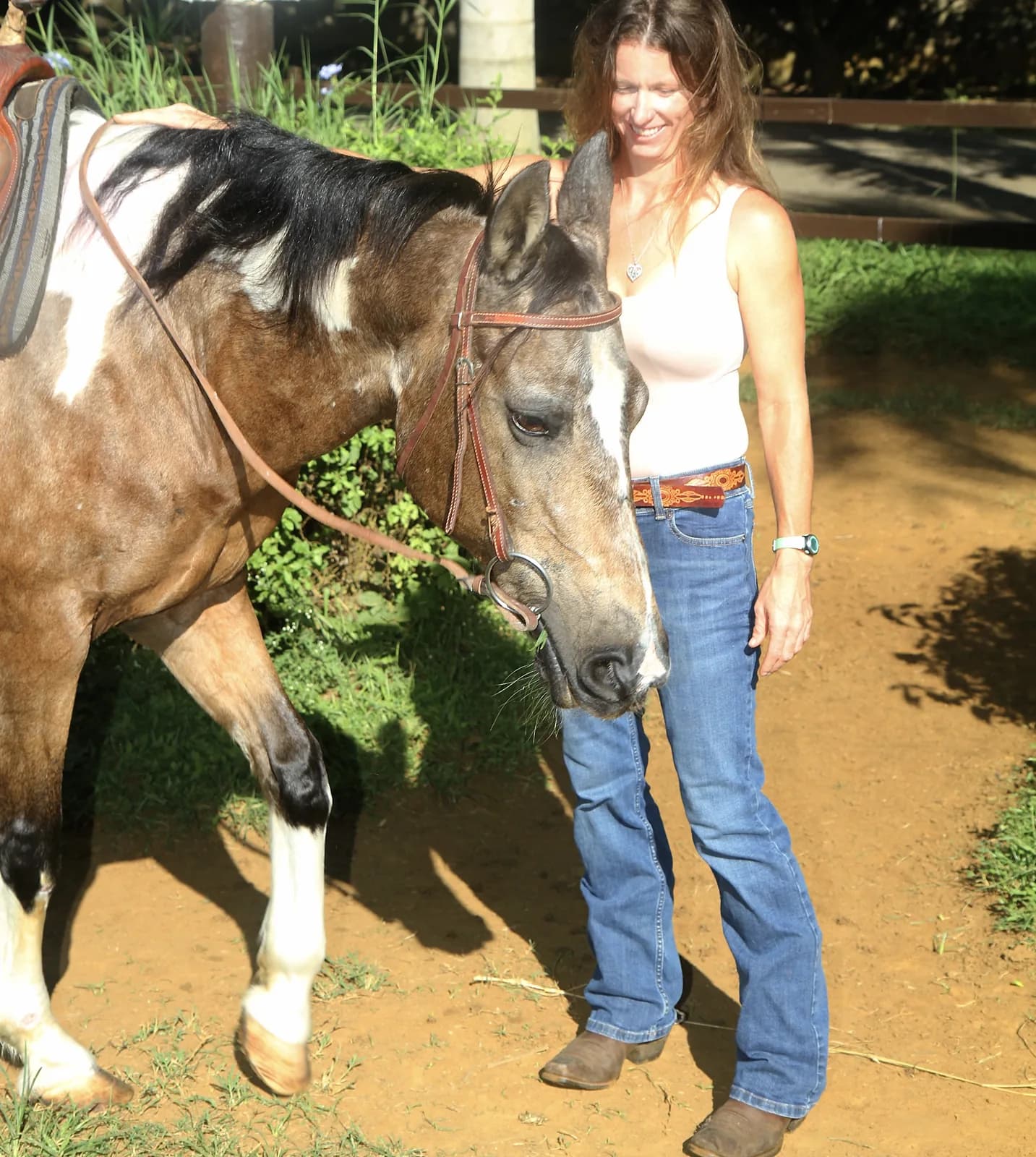
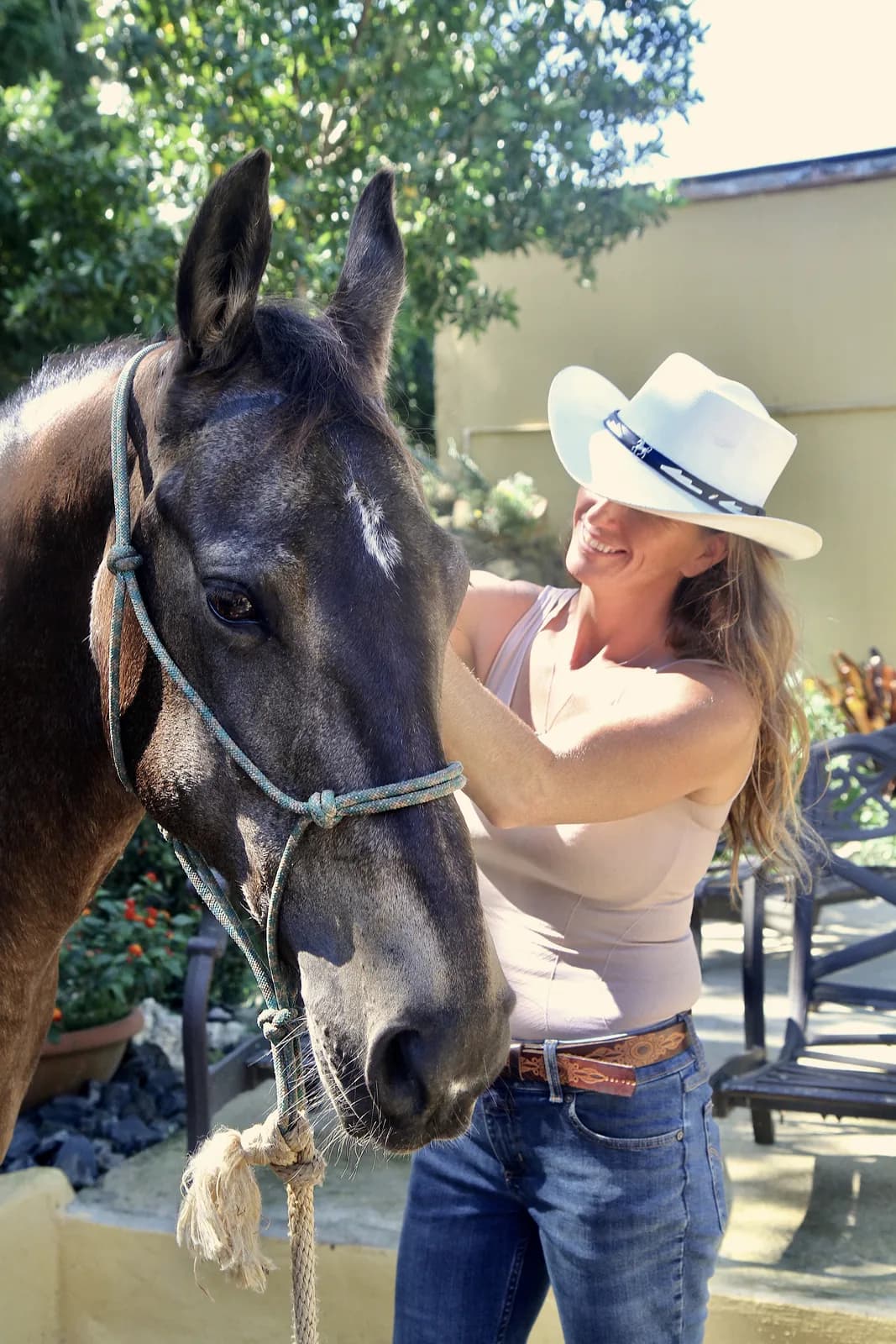
All of it, five centuries, ends up as two mares in the northwest corner of Puerto Rico. Dolly came down from the mainland as a retired barrel racer and is now the horse beginners get put on, because she has already done everything and none of it worries her. Sadie is her daughter, born here.

Kellie will tell you the Paint is her favorite breed. Everything above this is the long way of explaining why anyone would have a favorite.

Sadie, at Hacienda Los Ponce

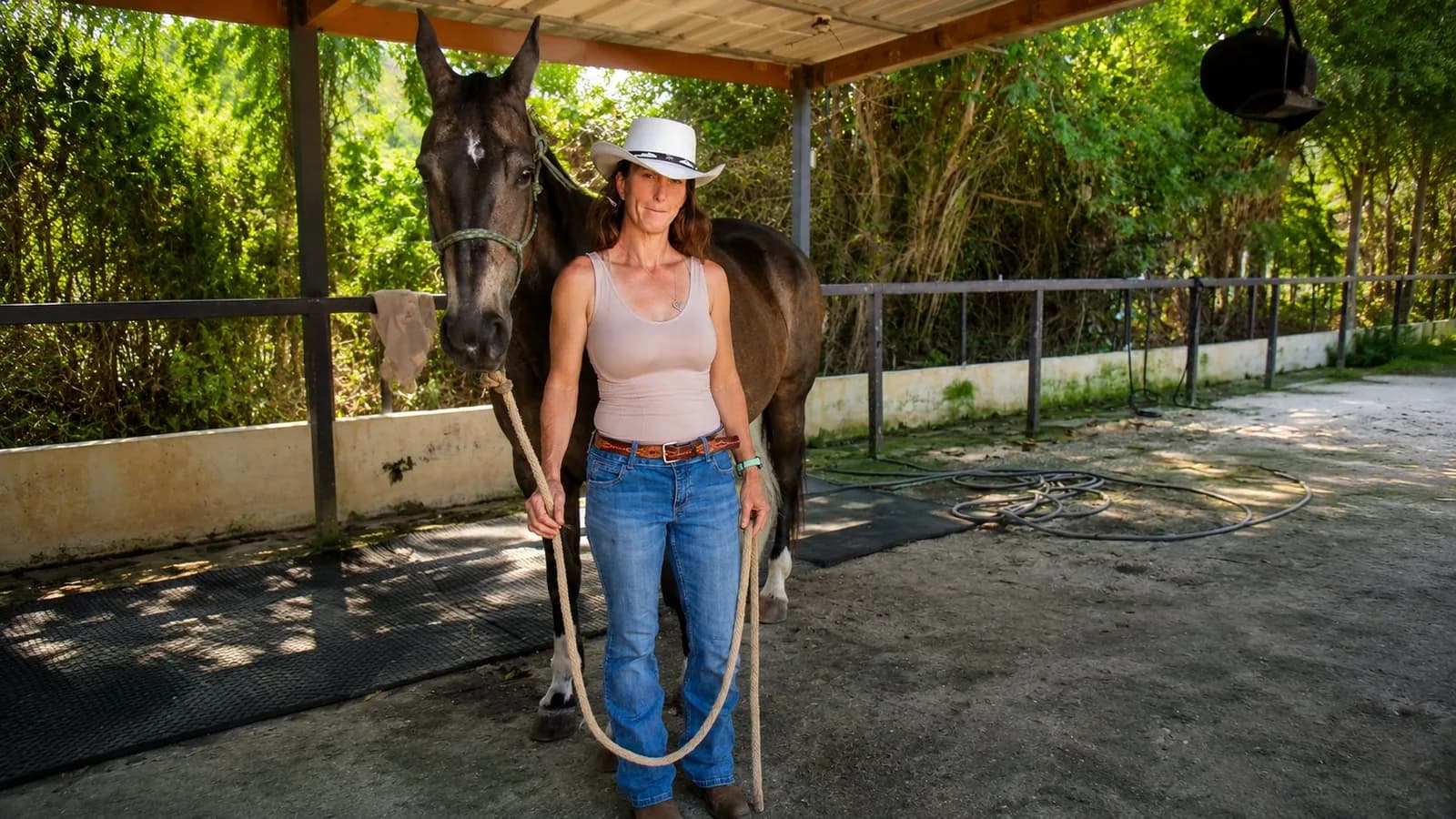
Dolly, a buckskin paint mare, haltered beside her handler

Dolly

The one you learn on

A retired barrel racer from the mainland. Calm, experienced, and the horse I put beginners on. She is the steady one the rest of the herd learns from.

  • Good for beginner riders
Sadie, a dark paint mare, being haltered

Sadie

The one who stays

Dolly’s daughter. She got her mother’s temperament and is a natural with people. She stays here and works with me.

  • Not available to rent

Both are on the horses page. If you want to ride one, rental is here, and the training program takes any breed.

Questions

The three that always come up.

What is the difference between a Paint and a pinto?

Pinto is a color and Paint is a breed. Any horse of any breeding can be a pinto, meaning patched white and dark. An American Paint Horse has to be a pinto and also has to have the pedigree: the sire and dam registered with the APHA, the American Quarter Horse Association or the Jockey Club, with at least one parent a registered Paint. That is why the APHA describes itself as a breed registry rather than a color registry.

What is the difference between tobiano and overo?

Mostly it is whether the white crosses the horse’s back. Tobiano is rounded patches that run over the topline between the withers and the tail, usually with white legs and a dark head. Overo is jagged, horizontally oriented white on the sides that stops short of the back, usually with dark legs and a white face. Overo is not one pattern but three unrelated ones: frame, sabino and splashed white.

What is lethal white overo syndrome?

A foal that inherits two copies of the frame gene is born looking healthy and almost entirely white, but with a colon that cannot function, and it dies within days. One copy causes no harm at all: carriers are ordinary healthy horses. It only happens when two carriers are bred together, and there has been a DNA test for it for years, so it is now entirely avoidable.

Want to meet a Paint in person? Come to Isabela.

Hacienda Los Ponce, Isabela, Puerto Rico. Email barefootridingpr@gmail.com or call and WhatsApp 904.705.2294. I answer within 24 hours.

Sources

Where every date on this page came from.

Breed history collects a lot of repeated guesses, and this breed collects more than most. Everything above is traceable to one of these. The one claim we could not source is on the page as an unsourced tradition and is labeled as one.

  1. American Paint Horse Association, "The History of APHA"Rebecca Tyler Lockhart, the sixteen founders at Gainesville on 16 February 1962, the first year figures, Bandit’s Pinto as registration number one, the West Texas association, the 1965 merger, and the registry’s size today.
  2. Texas State Historical Association, "The Formation of the American Quarter Horse Association in 1940", Texas Day by DayThe founding of the AQHA on 15 March 1940 at the Fort Worth Club during the Southwestern Exposition and Fat Stock Show, the roughly seventy five people present, its origin in Robert M. Denhardt’s articles of the 1930s, and the registry’s stated purpose of recording and preserving stock horse pedigrees.
  3. Wikipedia, "American Paint Horse"The 1940 AQHA exclusion of pinto and crop-out horses, the stock horse conformation standard, the bloodline requirement, the four registered coat categories, and solid Paint-bred registration.
  4. Wikipedia, "Lethal white syndrome"The EDNRB Ile118Lys mutation, the 25, 50 and 25 percent outcomes of a frame to frame cross, carriers being healthy, cryptic frames, and the point that breeding two frames gives no better chance of a frame foal.
  5. Metallinos, D. L., Bowling, A. T. and Rine, J., "A missense mutation in the endothelin-B receptor gene is associated with Lethal White Foal Syndrome", Mammalian Genome 9(6) (1998)Identification of the EDNRB mutation behind lethal white syndrome, and the finding that every frame overo horse tested was heterozygous for it.
  6. Vrotsos, P. D., Santschi, E. M. and Mickelson, J. R., "The Impact of the Mutation Causing Overo Lethal White Syndrome on White Patterning in Horses", AAEP Proceedings 47 (2001)That frame carriers are routinely misidentified by eye, including among horses registered as solid and among horses registered as tobiano.
  7. Brooks, S. A., Lear, T. L., Adelson, D. L. and Bailey, E., "A chromosome inversion near the KIT gene and the Tobiano spotting pattern in horses", Cytogenetic and Genome Research 119 (2007)Tobiano being caused by a large paracentric inversion on horse chromosome 3 that begins about 100 kilobases downstream of KIT and interrupts no gene, most likely disrupting its regulatory sequence instead.
  8. Wutke, S. et al., "Spotted phenotypes in horses lost attractiveness in the Middle Ages", Scientific Reports 6, 38548 (2016)Tobiano identified in Neolithic horses in Europe and central Asia, thousands of years before the Americas, its rise through the Iron Age and its decline in the Middle Ages.
  9. Taylor, W. T. T., Librado, P. et al., "Early dispersal of domestic horses into the Great Plains and northern Rockies", Science 379 (2023)The Iberian genetic origin of early North American horses, their spread into the northern Rockies and central plains by the first half of the seventeenth century through Indigenous exchange networks, and their integration into Indigenous societies before European observers arrived.
  10. Ewers, J. C., "The Horse in Blackfoot Indian Culture", Bureau of American Ethnology Bulletin 159, Smithsonian Institution (1955)The 1680 record of Oto visitors bringing a piebald horse to La Salle at Fort Crevecoeur, which is the earliest dated attestation we could find of a pinto horse in Indigenous hands on the plains.
  11. Oklahoma State University, Department of Animal and Food Sciences, "Pinto Horses", Breeds of LivestockPinto horses reaching North America with Spanish Barb stock, and the camouflage explanation, which this source itself gives as something traditionally regarded rather than as documented fact.
  12. Diaz del Castillo, B., Historia verdadera de la conquista de la Nueva Espana, reproduced by Noticonquista, Instituto de Investigaciones Historicas, UNAMThe roster of horses on the 1519 expedition, in which two are recorded as overo. Sixteenth century Spanish color terms are not the modern registry ones, so the page says what the roster says and no more.
  13. Paso Fino Horse Association, "Color Chart", Paso Fino Horse World (2011)Pinto being one of the colors a Paso Fino can be registered as, with tobiano and overo nameable on the certificate.
  14. The Livestock Conservancy, "Puerto Rican Paso Fino Horse"The Iberian types behind the island’s horses, and that the breed is open on color.

From the blog

All 6 posts